Follow Us
Popular posts
- What If Dyson Made CNC Routers Instead of Vacuum Cleaners?
- CNC 4th Axis Basics: Routers and Woodworking
- 10 Tips for CNC Router Aluminum Cutting Success
- MIT Students Create Hand-Held CNC Router: You Gotta See This!
- Hexapod Robotic CNC Router Walks to the Site of the Work to Be Done
- Tale of Two Engines: Giant Crankshaft and World’s Smallest V12
- CNC 4th Axis Basics: Workholding
- Desktop Manufacturing is Here With Two Amazing Announcements
- CNC’ing the World’s Ultimate Pizza Cutter
- Several Customer-Driven Updates to G-Wizard Editor This Week
Recent Comments
- Take the CNCCookbook 2013 CAD Package Survey - CNCCookbook CNC Blog CNCCookbook CNC Blog on Results from the 2012 CNCCookbook CAM Software Market Share Survey
- Jamie Fritz on What If Dyson Made CNC Routers Instead of Vacuum Cleaners?
- MeshCam is Here By Itself - CNCCookbook CNC Blog CNCCookbook CNC Blog on MeshCAM: Great Ease of Use in a 3D CAM Package
- SiteOwner on Magnetic Sheet Metal Bending Brakes
Categories
- 3D Printing (22)
- Beginner (88)
- Blog (593)
- Business (55)
- CNC Projects (118)
- CNC Router (28)
- Cool (139)
- FeedsSpeeds (47)
- GCode (51)
- Guest-Post (10)
- Manual (8)
- Products (49)
- Software (177)
- Techniques (219)
HSM Toolpaths Chapter Added to Feeds and Speeds Cookbook
I just finished posting the HSM Toolpaths chapter to the Feeds and Speeds Cookbook. If you’ve been wondering why those crazy swirly toolpaths are so popular, what the advantages for them might be, or how to figure feeds and speeds for HSM, check it out.
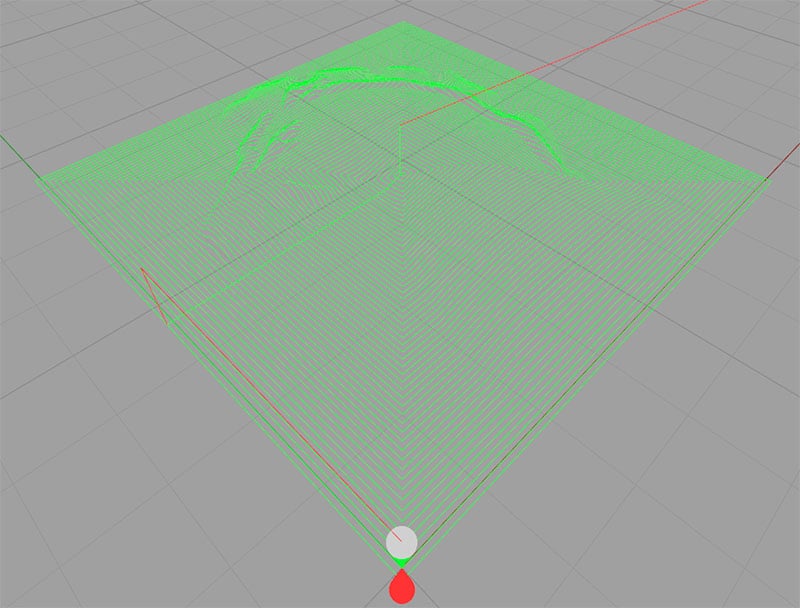
Comparison of the same pocket done with HSM and conventional toolpaths in GibbsCAM as shown by the GWE CNC Simulator…… Read the rest
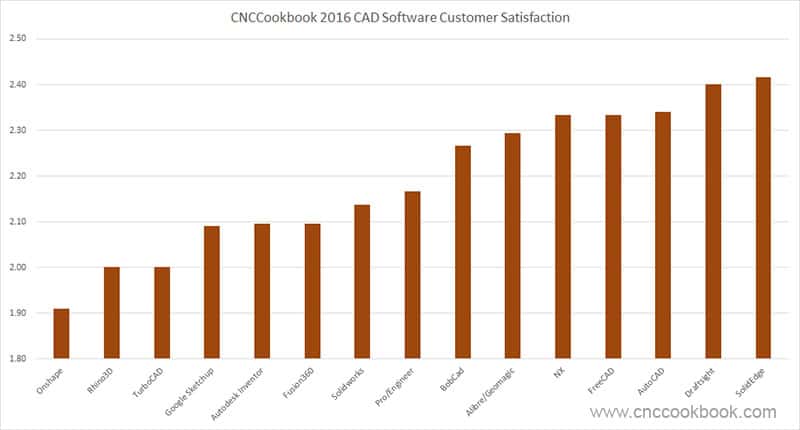
Which Software Product Should We Build Next?
We’re making good progress on G-Wizard Editor, so it looks like it will be out before end of year. Of course just saying that out loud probably jinxes the schedule, software being what it is, but it’s time to at least start dreaming about new products.
Give us your input on that dreaming. We’re running a survey on what sort of software we should think about building next.… Read the rest
Minimizing Chatter, Finding Stable Milling Speeds, and More
Every machinist hates dealing with chatter. The worst cases will tear apart your tooling, ruin your job, and wear out your machinery before its time. Not to mention, it just sounds terrible. I flinch every time I fire up a cut and a big dose of it comes back at me. It turns out you don’t have to put up with chatter. Even better, the answer doesn’t always have to be, “Slow way down.” Instead, you need to find the Stable Milling Speeds for your machine and tooling combination and use that.… Read the rest
Adding Infinite Loop Detection and Macro Stepping to G-Wizard CNC Editor
I got an inquiry from a G-Wizard G-Code Editor user wanting to know if I could help diagnose a problem he was having. It seems he was trying to figure out why a program that had been output by his BobCAD CAM software was getting an error message out of Mach3. I his post wasn’t set up quite right for the Mach3 g-code dialect at first, but his description of the problem was intriguing and sounded deeper than that, so I volunteered to try to help. He had run the code through the Predator Editor/Simulator that comes with BobCAD, but it saw no errors.… Read the rest
Wondering How a Manual Machinist Can Learn to Use CNC Quickly?
If you’re a manual machinist, you’ve probably wondered about CNC. Maybe you’ve heard others talking about how CNC is only good for producing lots of copies of the same part, and prototyping is much faster on a manual machine. That just isn’t true! In fact, once you get the hang of it, you can make a CNC act just like a manual machine that has power feeds on every axis and a DRO. You’ve got to admit, you really could do some wicked cool prototypes on a machine like that.
Gotta love those old tracer machines!… Read the rest
Added Coordinate System and G-Code Dialect / Post Processor Articles to CNCCookbook’s Online G-Code Learning Course
As promised, we’re adding additional articles to our Online G-Code Course and Tutorial at a rapid clip. I just added a new article on G-Code Coordinate Systems and another on G-Code Dialects and Post Processors. These articles will answer questions like:
What is a Post Processor or “Post”?
What are some of the differences in G-Code dialects and what are the most common dialects?
What’s the difference in right-handed versus left-handed coordinate systems and should you care?
Why are all the arcs plotting wrong in my controller or GWE’s G-Code Simulator and how do I fix it?… Read the rest
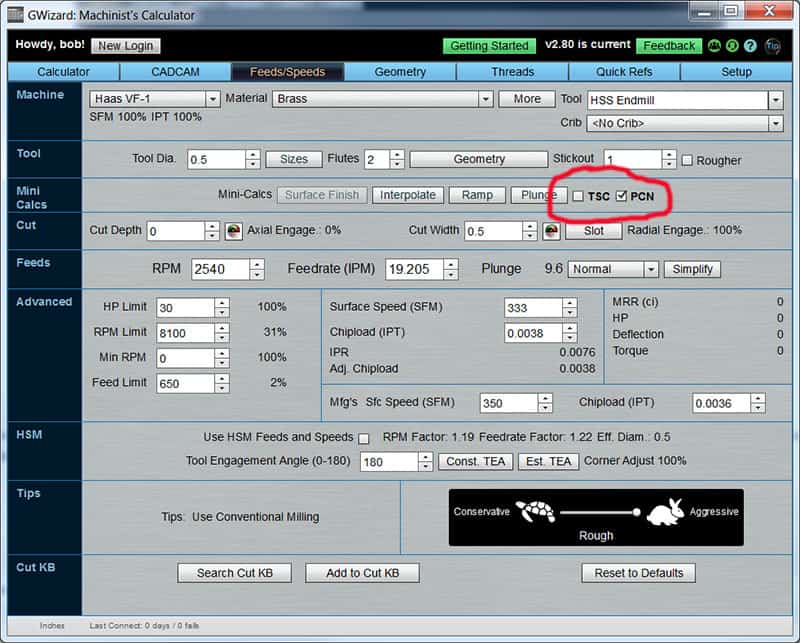
G-Wizard v1.52 Adds Power Tools for Machinists: Constant Engagement Toolpaths, Plunge Roughing, Through Spindle Coolant, and Programmable Coolant Nozzle Support
I get to hear constantly from our many customers about what they’d like us to add to G-Wizard next. It’s one of the great pleasures of this job, and it makes me smarter every time I get to talk to a customer. They’re often puzzled when I tell them that, particularly when all they’re doing is asking questions. From their perspective, they called because they were confused. They can’t see how someone can learn from a confused person. But I operate from the perspective that says it was our software that confused them, LOL, so therefore at the very least I got to learn what areas to make less confusing.… Read the rest
Revisions: G-Code Transformations with the G-Wizard G-Code Editor
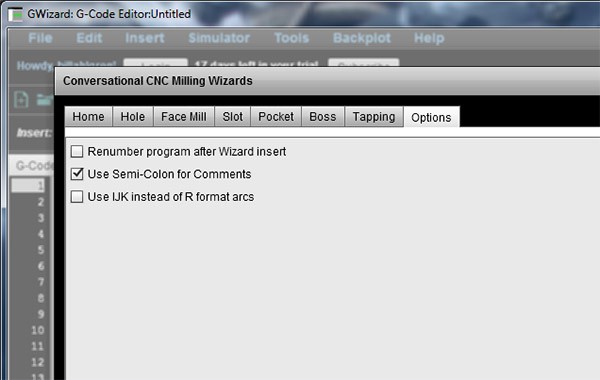
G-Wizard Editor is CNCCookbook’s G-Code Editor and Simulator. GWE version 0.138 was just uploaded the other day. Since it’s unfinished and still in Beta test, GWE is free until the Beta ends. Go ahead and click the link and sign up so you can play with it.
For this post, I want to talk about a unique feature in GWE called “Revisions”. Think of a Revision as a sort of automated editor that makes a particular change to your g-code. Examples of Revisions include:
Adding or deleting spaces and blank lines.… Read the rest
How To Choose a Stepover
This is a guest post by Robert Grzesek, founder of Grzsoftware and creator of the excellent MeshCAM 3D CAM software. This post originally appeared on the Grzsoftware Blog, and I will be incorporating Robert’s excellent article on stepover for 3D profiling into the Milling Feeds and Speeds Cookbook, but I wanted to post it to the CNCCookbook Blog to make sure everyone sees it. It’s a very clear explanation of how to choose a stepover and I particularly like his analysis of the “sweet spot” for stepover. Very useful knowledge to have!… Read the rest
CNC Software: Digital Tooling for CNC
Our recent article on Digital Tooling has been very popular so we recently started working on a new Cookbook series around software. The first installment is an overview of all the different kinds of software available for CNC Manufacturing called “CNC Software: Digital Tooling for CNC“. We’ll be following up with a series of sub-articles that look at the various categories in more detail.… Read the rest
Breaking Cutters With Tool Deflection: An Anecdote
This is article is part of the new Tool Deflection page in the Milling Feeds and Speeds Cookbook.
Not long ago I got a call to go visit a shop and check out their new Volumill HSM module for GibbsCAM. Being a fan of HSM techniques, I couldn’t resist. Volumill is indeed very slick, though we noticed it was leaving some pretty severe nicks in the walls and rough spots in the floor of a pocket. My friend commented that the dealer had suggested Volumill was focused on roughing, and so not having a smooth finish was really not an issue.… Read the rest
What’s Your Digital Tooling Budget?
When I was learning to be a manual machinist, people used to say, “Budget as much for tooling as you do the machine.” Danged if they weren’t spot on right. In fact, if you wanted to be well tooled up (and what machinist wouldn’t?), you could even leave off your measuring tools from that budget and focus on workholding, fixturing, toolholding, cutters, and the like. If they aren’t already on the machine, you have to put a DRO and any power feeds in this category as well. Powered drawbar is mighty nice to have too.… Read the rest
Close to Canned Lathe Cycles for G-Wizard G-Code Editor (G71 Sneak Peek)
If you’re wondering why it’s been a while since there’s been a new G-Wizard Calculator or G-Code Editor (and Simulator) release, it’s because I’ve been buried under a mountain of code working feverishly (yeah, I had the flu too, BTW) on canned lathe cycles for the G-Wizard G-Code Editor. These little beauties are almost like having a mini-CAM program buried in your CNC Controller. In fact, I know a number of machinists who don’t bother too much with Lathe CAM because they have tools like this to simplify their jobs. The good news is the canned lathe cycles can save you a lot of work, the bad news is they’re devilishly complicated to implement in a controller, or in a simulator like GWE.… Read the rest
Turning Down the Heat in a Cut
Heat is the enemy of your cutting tools. The history of cutting tool improvements has largely been about making tools that can stay sharp when it gets hot, hot, hot in the kitchen. Coatings like TiAlN even thrive on a certain amount of heat and have to be run to achieve their threshold temperatures before the full value of the coating can be activated.
The problem with heat is that it softens your tool’s cutting edges. Not long after such softening, that tool will be done and will need to be replaced.… Read the rest
Carbon Fiber Wingtips for a Fighter Plane, Part 2
I recently wrote about a project a friend was doing to create a set of custom wing tips to improve the aerodynamics of an L-39 Albatross jet fighter. To refresh your memory, here is the shape he was looking for:
Cool project!
This project has ultimately involved making a number of molds using a big CNC router (gantry mill) to capture all the components for the wingtips. In this installment, I want to walk through the vacuum-bagging process that was used to make the parts with the molds.
When last we left our project, we had just finished CNC’ing and prepping this nice mold…
The mold process is called “vacuum bagging” and requires a vacuum pump.… Read the rest