Browsing articles in "Beginner"

3D Printing 101: Part 4: Software

May 1, 2013   //   by Michael Hackney   //   3D Printing, Beginner, Blog, Software  //  1 Comment

This week I’ll discuss the 3D Printing software tool chain. For the most part, I’ll focus on commonly used Open Source software that runs on Windows, Mac OSX and Linux operating systems.
3D Printing 101: Part 1: 3D Printer Basics
3D Printing 101: Part 2: Mechanics
3D Printing 101: Part 2a: Delta Robot Mechanics
3D Printing 101: Part 3: Electronics
>>3D Printing 101: Part 4: Software
3D Model to 3D Object: 3D Modeling
The  3D printing software tool chain begins with CAD to create the 3D model. Most of the commercial and Open Source CAD software packages are used to create 3D models for CNC milling can be used to create 3D models for printing. … Read the rest

Help Finding Stuff Like the Install Pages and Our Deal Pages

Apr 25, 2013   //   by Bob Warfield   //   Beginner, Blog, Software  //  No Comments
BeatlesHelp

I just updated the Software Home Page to make it easier for folks to find some key things on CNCCookbook.  If you scroll down the page you’ll see two new entries:
-  A MeshCam page link.  MeshCam is a super easy to use 3D CAM package by Robert Grzesek that we resell with some special deals.
-  A link to our “Cheapskate Page.”  You can always find any special offer we’re running on the Cheapskate Page, including volume deals, deals when you buy more than one product, sales, coupons, educational discounts, volume discounts, and probably even “Just Because Bob Says” discounts some days!… Read the rest

CNC 4th Axis Basics: What They Can Do

Apr 8, 2013   //   by Bob Warfield   //   Beginner, Blog, Techniques  //  8 Comments
HA5C-First-Model

4th Axis machining is an interesting and important sub-part of the CNC milling world.  Haas actually got it’s start building a 4th axis before it ever built entire CNC machines (pictured on the right).  This is an article series to help beginners understand how and why a 4th Axis is used on CNC Mills.  In the first installment, we’ll look at what a 4th axis is used for.  In the second, we’ll look at how they work.
If you’re new to CNC, your first impression may be that the 4th axis is used in the same way a rotary table is used for manual machining.  … Read the rest

3D Printing 101: Part 2a: Delta Robot Mechanics

Apr 4, 2013   //   by Michael Hackney   //   3D Printing, Beginner, Blog  //  No Comments

In my earlier post this week on 3D printer Mechanics, I focused on the more traditional Cartesian printer geometry. I closed the post with a mention that I’d follow-up with a post on a really exciting new development in 3D printer mechanics – the delta robot printer.
A Little Background
According to Wikipedia, a delta robot is a parallel arm robot invented in the early 1980s. The delta format was developed to manipulate light and small objects at high speeds. Here us a photo of a row of delta robots picking parts:

Unlike a Cartesian geometry, the delta robot has three fixed length arms arranged 120° apart on the perimeter of a circle.… Read the rest

3D Printing 101: Part 2: Mechanics

Apr 2, 2013   //   by Michael Hackney   //   3D Printing, Beginner, Blog, Guest-Post  //  3 Comments

 
In this installment of 3D Printing 101 I am going to look at the mechanical aspect of a typical 3D printer. Before I jump in, I should say that there are many different additive manufacturing technologies (i.e. 3D printers) but this series will focus on plastic filament extrusion printers that are the most familiar to hobbyists. After this initial series, I’ll follow-up with a post on some alternative technologies and point our their similarities and pluses and minus as compared to filament extrusion printers.
3D Printing 101: Part 1: 3D Printer Basics
>> 3D Printing 101: Part 2: Mechanics
3D Printing 101: Part 3: Electronics
3D Printing 101: Part 4: Software

A Little Math
Most readers of the CNCCookbook are familiar with CNC routers and milling machines that typically feature 3 axes of movement.… Read the rest

3D Printing 101: Part 1: 3D Printer Basics

Mar 25, 2013   //   by Michael Hackney   //   3D Printing, Beginner, Blog, Guest-Post, Techniques  //  4 Comments

Since the CNCCookbook Blog is frequented by CNC machinists, I thought it would be useful to provide an overview on 3D printing from the perspective of someone familiar with CNC machining. I have four parts planned, and in this first part I’ll present a little history, describe why I (and many others) believe 3D printing is here to stay, discuss some terminology, and generally set the stage for future posts in the 3D Printing 101 series:
3D Printing 101: Part 1: 3D Printer Basics
3D Printing 101: Part 2: Mechanics
3D Printing 101: Part 3: Electronics
3D Printing 101: Part 4: Software
So, let’s get started!… Read the rest

What Now: My CNC Won’t Go Slow Enough or Fast Enough?

Mar 15, 2013   //   by Bob Warfield   //   Beginner, Blog, CNC Router, Software, Techniques  //  No Comments
594037_Donkey_cart

It takes a complex bunch of math to properly calculate Feeds and Speeds under all conditions and to get anywhere close to good answers.  There is a whole lot more to it than the basic equations everyone learns that claim to relate surface speed, chipload, rpms, feedrates and the like.  Unfortunately, those equations work reasonably well for manual machining (though you can still do much better with proper calculations), but they can be way off for typical CNC operations.  When I first started out, I was using an Excel spreadsheet to keep up with it all.  … Read the rest

Super Easy 4-Jaw Chuck Alignment and Neat QCTP Indicator Holder

Feb 25, 2013   //   by Bob Warfield   //   Beginner, Blog, Techniques  //  4 Comments

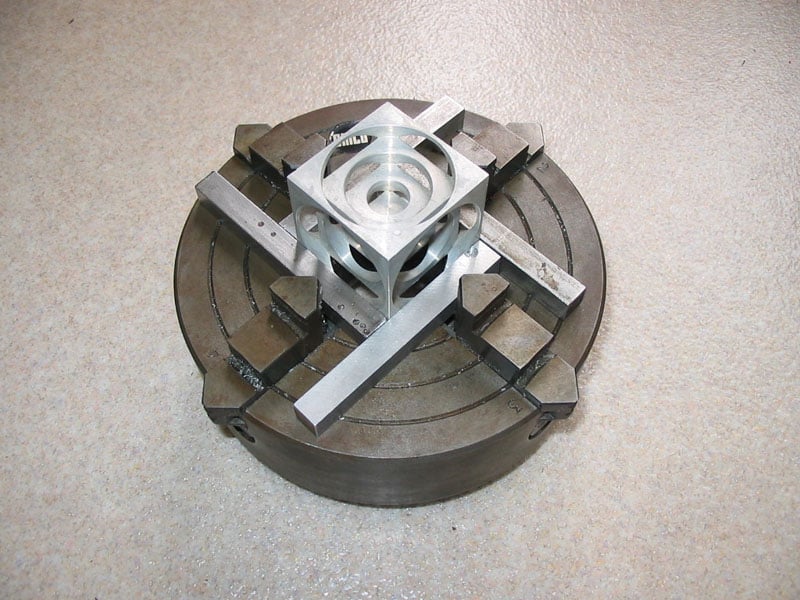
The 4-Jaw Chuck is one of the most versatile workholding solutions for turning, but many beginners are afraid of them.  They reason that it’s too much touchy trouble to align the 4-jaw so the work is centered.  Once you get used to this vital machinist’s skill, nothing could be further from the truth and they’re easy to set up.  But, there’s nothing wrong with making them even faster and easier.
I got a nice letter from Aaron Gough, who had just watched a video he found on CNCCookbook’s Lathe Workholding Page by David Lemeris:

David’s method is the one I use and it is super fast and easy.  … Read the rest

Two New Categories for CNCCookbook Blog: FeedsSpeeds and GCode

Feb 23, 2013   //   by Bob Warfield   //   Beginner, Blog  //  No Comments
Card Catalogue - One Draw

We try to make it as easy as possible to find what you’re looking for on CNCCookbook, but there’s just an awful lot of content here.  So, we’re constantly looking for ways to improve the organization and navigation.
Towards that end, I just introduced two new Categories you can use to navigate the blog posts:

FeedsSpeeds:  Articles about feeds and speeds, coolant, G-Wizard Feeds and Speeds Calculator, and all things related to our Feeds and Speeds Tutorial.
GCode:  Articles related to gcode programming, G-Wizard GCode Editor, and all things related to our G-Code Course and Tutorial.… Read the rest

9 Easy G-Codes Every Machinist Must Learn

Feb 11, 2013   //   by Bob Warfield   //   Beginner, Blog, GCode  //  1 Comment

For those of you who are manual machinists and still wondering what CNC can do for you, there are 9 basic g-codes you must learn today.  If you know them, and they are easy, they will turn the CNC Machine into the equivalent of a manual machine with power feeds and DRO’s on every axis.  They do this because you can use them as simple immediate commands without having to write a g-code program.  You just type in one of these 9 gems and the machine will perform that action immediately through the magic of what’s called “MDI” or “Manual Data Input.”  MDI is like the command line prompt from DOS for CNC and it is handy as can be for quick and dirty operations.… Read the rest

4 Easy Steps to the Best CNC Feeds and Speeds

Jan 19, 2013   //   by Bob Warfield   //   Beginner, Blog, FeedsSpeeds, Software, Techniques  //  1 Comment

I just uploaded a new video showing how to get the best CNC Feeds and Speeds with 4 easy steps using our G-Wizard Calculator:

It also goes through the reasons why a calculator can give better feeds and speeds than your tooling manufacturer’s feeds and speeds charts.… Read the rest

Gear Puller: A Quick CNC Plasma Table Project

Jan 7, 2013   //   by Bob Warfield   //   Beginner, Blog, CNC Projects  //  No Comments

Keith Fenner of Turn Wright Machine Works has a bunch of neat videos on YouTube.  Most of them involve manual machining and especially repair work, but he has a CNC Plasma Table that sees a fair amount of use too.  In this video, he is throwing together a quick little gear puller that can be used to pull steering wheels and the like:

I liked the video because it shows a complete project and gives a sense of what’s possible with a machine like a plasma table, waterjet, or laser cutter that really simplify projects like this.  … Read the rest

Why Use a Single Flute End Mill?

Dec 23, 2012   //   by Bob Warfield   //   Beginner, Blog, CNC Router, FeedsSpeeds, Techniques  //  No Comments
when to use a single flute end mill

There are a lot of strange beasts out there in the cutting tool world, and a lot of physics that are not obvious.  For example, many machinists will know that more flutes means more productivity, but that certain materials, like aluminum, require fewer flutes–usually two or three.  If that’s the case, when would it ever make sense to use a single flute end mill?  Is there a time when the least number of flutes possible is a good idea?
In a word, “Yes!”  Let’s talk about why.
The reason we use fewer flutes in some materials has to do with the behavior of chips in those materials.  … Read the rest

Clearing Welded on Aluminum from Endmills, Drill Bits, and Inserts

Nov 27, 2012   //   by Bob Warfield   //   Beginner, Blog, Techniques  //  No Comments
aluminum clogged endmill

Anyone who has machined much aluminum will sooner or later wind up with an endmill like the one shown in the photo (thanks Practical Machinist and Bobw):

Aluminum welded to and clogged the flutes of this endmill…
The same can happen to twist drills and inserts.  Aluminum is a sticky material.  You’ll need the right lubricant or coating on your tools to cut it successfully without the welded on aluminum, and even then, you can still get it if you push too hard.  The aluminum comes out looking like taffy.  Interesting to look at, but unless you’re real fast with the red button, it will break the endmill pretty quickly and possibly screw up the job you’re machining.… Read the rest

CNC Knifemaking: Grimsmo + Tormach Style

Nov 19, 2012   //   by Bob Warfield   //   Beginner, Blog, CNC Projects, Cool  //  1 Comment

John Grimsmo’s latest Knifemaking Tuesday video is all about the course he taught at Tormach on how to use CNC machines for knifemaking:

I always enjoy John’s videos, but this one really brought a big grin to my face.  Clearly those guys were having a ball playing with the Tormach mills and making their own custom knives.  They got to touch on the use of the CNC Mill, CAM software, heat treating the blades, fixing warped blades on an arbor press, and a host of other areas, I’m sure.  Hopefully they’ll teach it again next year.… Read the rest

Pages:123456»

Home

Software

  GW Calculator

  GW Editor

  Gearotic

  Conversational

  Deals and Steals

CNC Blog

  Software

  Techniques

  Beginner

  Cool

  Projects


Cookbooks

     Feeds and Speeds

     G-Code Tutorial

CNC Projects

CNC Machines

     Lathe: Soon!

     Mill: Soon!

     Router: Soon!

     Plasma Table

     3D Printer: Soon!

     Welding

     Other Machines

Resources

     Machinist's Search

     Videos

     Online Groups

     Individuals

     Reference Data

     Books

     CNC Dictionary

     Suppliers

     Tool Brands

Workshop

     Hall of Fame

     Organization: Soon!


About

     Customers

     Partners

     Our History

     Privacy Policy

 
All material © 2010-2012, CNCCookbook, Inc.